
DC traction · Rail and tram
Stray current mitigation.
Traction current doesn't stay on the rail. Where your pipeline runs near a tram or rail corridor, protection has to cope with something that moves — and a bigger rectifier isn't the answer.
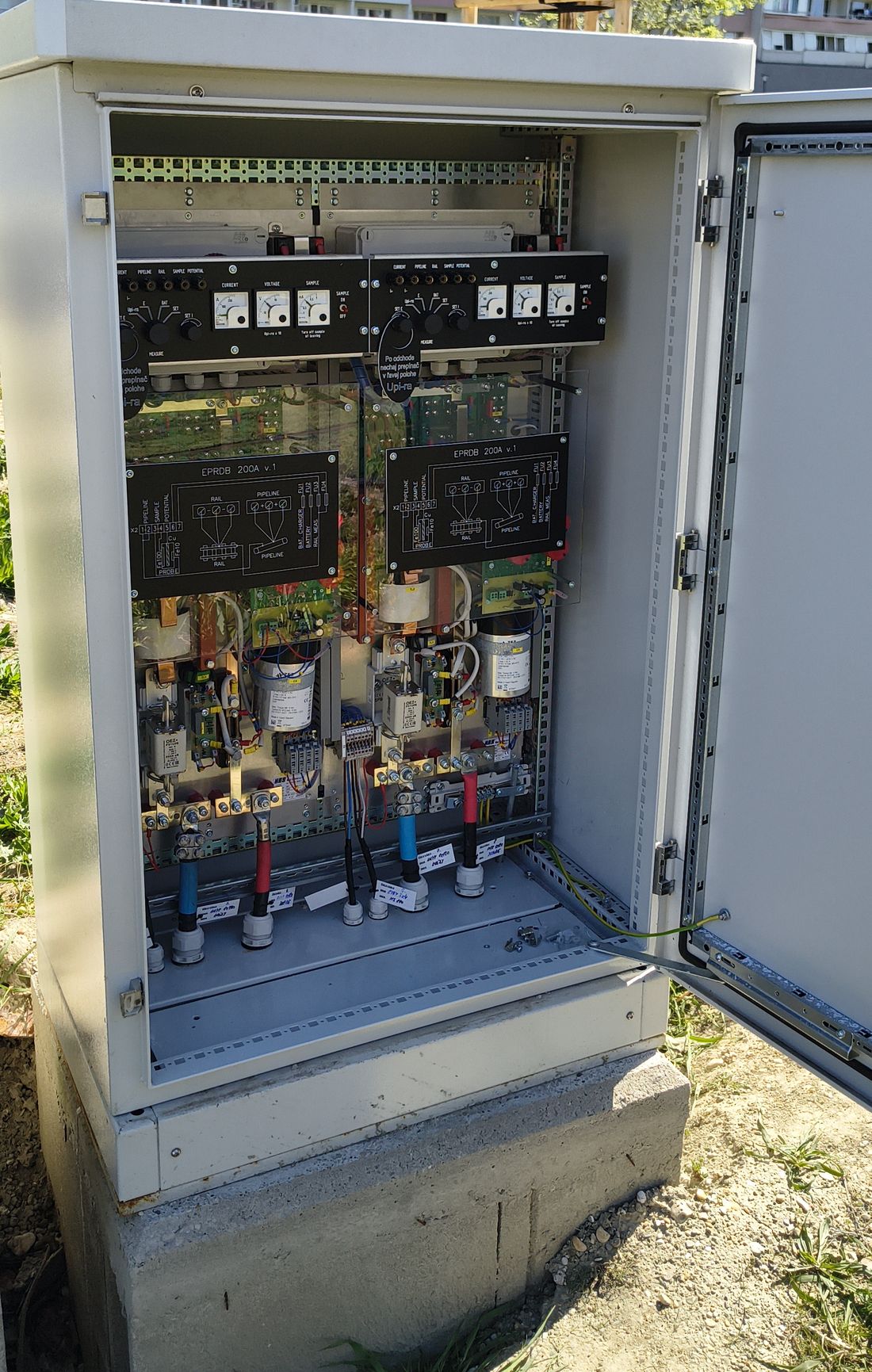
Aegis Sentinel supplies the NES range built specifically for this problem — passive and forced drainage equipment.
The problem
Current takes the easiest path back
DC traction returns through the running rails — in theory. In practice, some of it leaks into the ground and finds your pipeline, which is a far better conductor than soil. It travels along it, and where it leaves to return to the substation, it takes metal with it.
1 A of current flowing for 1 year removes almost 10 kg of iron. The damage is fast, local, and worst where nobody's looking. Conventional cathodic protection assumes a steady environment; a traction network is anything but — the load changes every time a tram accelerates, in some instances reaching 6000 A DC.
Product range
Six tools, not one bigger box
Each addresses a different part of the problem. Which you need depends on the corridor, the structure, and what the traction authority requires.
SDU
Switching drainage units
Forced and passive drainage equipment in a large range of capacities for stray current mitigation on DC traction networks.
- Automatic and manual
EPD
Polarised electronic drainage
Monitors soil potential by probe and limits current from pipeline to rail. Activates on adverse pipeline–rail polarity, and can set a maximum drainage current regardless of other values.
- ±20 V tram · ±80 V rail traction
- 100 A/block, max 2×400 A
- Mains, stray current or solar supplied
- Outdoor cabinet
DOP
Polarisation cell replacement
Solid-state DC decoupling with AC continuity and earthing, for pipelines, tanks, grounding systems and cable casings. Higher blocking voltage than polarisation cells, so no need to place devices in series.
- 63 kA / 55 kA surge
- 400 V VRPM · 7100 A IFAV
- IP 65
SZKL
Linear rectifiers
Linear rather than switching, specifically to eliminate the impact of stray currents on the measurement and the output. For low-current sites in noisy environments.
- 10 mA – 300 mA / 24 Vdc
- Constant potential, voltage, current
SP 60C
Potential transducer
Band-rejection filter and transducer for measured potential, with galvanic separation to 4 kV. Balance set by rotary switch to suit the operation.
- 16⅔ Hz and 50 Hz versions
- −5 V to +5 V, 1:1
- DIN rail
SZ · RZ
Stray current simulator
Programmable power supply for simulating stray current conditions — for testing, commissioning and proving a mitigation design before it goes in the ground.
- 0 to ±50 V, max 20 A
- 1 kW continuous
- Microprocessor controlled
Why Sentinel
Drainage you can see
Stray current is intermittent by nature — it's worst at peak service, and a survey taken at 10am on a Sunday will tell you everything is fine. That's precisely the problem monitoring solves.
DataCell logs potential and drainage current continuously and reports into DataScape, so you're looking at what the corridor actually did all week rather than what it was doing while you stood there with a meter.