
NES Nová Dubnica · Exclusive Australian distributor
Cathodic protection rectifiers and transformer rectifier units.
NES Nová Dubnica has been building power electronics in Slovakia since 1992 — cathodic protection rectifiers and transformer rectifier units (TRUs), impressed current power supplies and switching drainage units. Aegis Sentinel is their authorised distributor in Australia.
That means the full range, with stock and spares held in Melbourne and engineers who can size a unit, commission it and support it afterwards. Every rectifier can report into DataScape, so you know what it's doing without driving to it — whether it's protecting a buried pipeline, a storage tank, a wharf or reinforced concrete.
Product range
1 A to 100 A, off the shelf
Standard units from 1 A to 100 A, with custom applications built for higher output. If what you need isn't listed, it's still available.
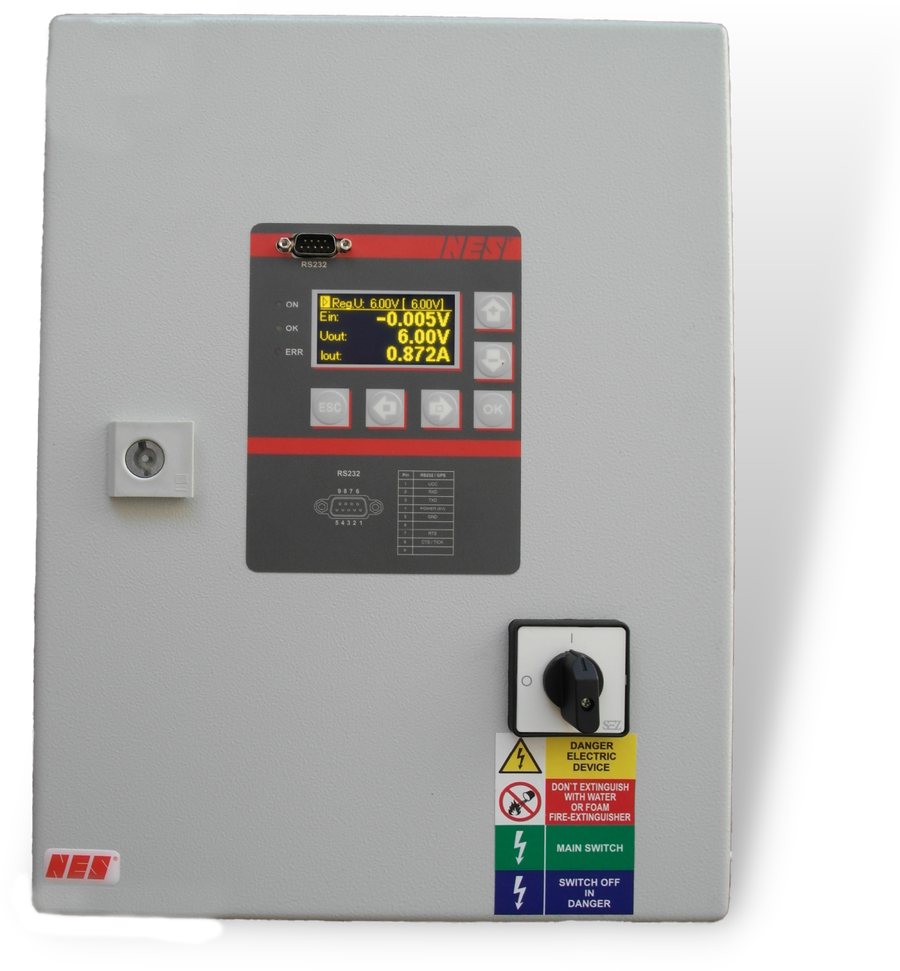
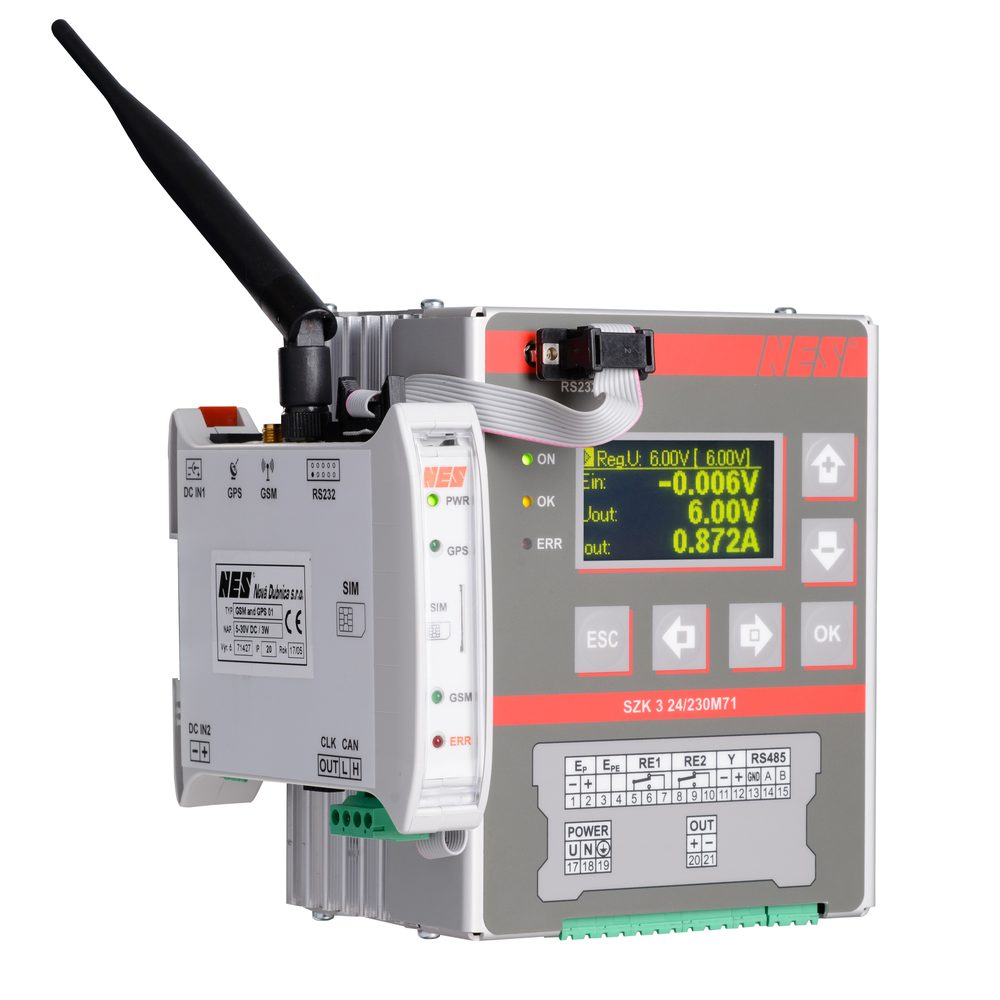
SZK Series
Air-cooled CP rectifiers
Switchmode impressed current transformer rectifier units in a robust steel enclosure. A wide range of output voltages and currents to suit pipeline, tank and structural protection.
- 1 – 100 A standard
- IP 55 / IP 65 options
SZKO Series
Oil-cooled CP rectifiers
For high-duty-cycle installations and environments demanding superior thermal performance and reliability.
- 50 A / 50 Vdc
- 58 °C ambient · IP 65
SDU
Drainage units
Automatic and manual switching drainage for stray current mitigation on DC traction networks. Fully compatible with VEC electrolysis committee requirements for the Victorian rail network.
- Tram and rail traction
- VEC compatible
Integration
Remote monitoring
All NES rectifiers integrate with DataScape via Modbus RTU/TCP — 24/7 remote monitoring, alarming and trending from a single dashboard.
- Modbus RTU / TCP
- RS-485 as standard
Modular
Multi-zone systems
Modular power and control modules for structures needing independent zones — reinforced concrete, tanks and offshore structures — with per-zone reference electrode measurement.
- Up to 32 power modules
- PLC and SCADA integration
Why Aegis Sentinel
Exclusive, and local
We're the exclusive Australian distributor, backed by an engineering team with deep cathodic protection expertise. Stock of common models and spare parts is held in Melbourne, with local commissioning and technical support across Victoria and nationally — so a fast response means days, not a shipment from Slovakia.
Compact design also makes these a straightforward replacement in an existing cabinet — and the integrated relay means instant-off surveys without extra hardware.
Where an asset warrants it, that support can be put in writing. Our optional service level agreement commits us to repair or replacement within seven business days, with remote diagnosis on monitored units and priority allocation from Australian spares stock.
More on how we work is on the capability page.
Specification
Key product features
Transformer rectifier units, or TRUs, are specified on three axes: power topology, regulation mode and enclosure rating. The NES range covers all three below.
Power
Switchmode IGBT
- Up to 92 % efficiency
- Output ripple < 1 % typical
- Wide input range — Australian 400 V / 230 V
- Surge and lightning protection
Control
E / U / I modes
- Constant current, voltage and potential
- Automatic and manual output adjustment
- Integrated current interrupter
- Integrated relay for instant-off surveys
Compliance
Standards
- CE marked — European and Australian standards
- AS 2832 compatible system design support
- VEC compatible drainage capability
- IP 55 and IP 65 enclosure options
Selecting a rectifier
How to size a transformer rectifier unit
Most specifications come down to four questions. Work through them in order and the model falls out at the end. If you'd rather hand it over, send us the structure details and we'll do the sizing.
Step one
Current demand
Start from the surface area to be protected and the coating condition. Well-coated buried steel may draw well under 1 mA per square metre; bare or badly degraded steel can draw two orders of magnitude more. Immersed and buried structures behave differently again.
- Structure surface area
- Coating type and condition
- Soil or water resistivity
Step two
Circuit resistance
Output voltage is driven by the total circuit resistance, not by the structure. Anode bed resistance usually dominates, with cable resistance and any back EMF added on top. A high-resistivity site can need several times the voltage of a low-resistivity one at the same current.
- Anode bed (groundbed) resistance
- Positive and negative cable runs
- Back EMF across the circuit
Step three
Headroom
Size for the asset at end of life, not at commissioning. Coatings degrade and anode beds gain resistance as they consume, so a unit chosen to exactly meet day-one demand will run out of output partway through the design life. Allowing meaningful margin on both voltage and current costs very little at purchase.
- Coating degradation over design life
- Anode bed consumption
- Future extensions to the structure
Step four
Regulation mode
Constant current suits most buried pipelines, where circuit resistance drifts but current demand is stable. Constant potential is preferred where a permanent reference electrode is installed and the structure-to-electrolyte potential must be held to a criterion. Constant voltage is the simplest and the least common.
- Constant current — pipelines
- Constant potential — with reference electrode
- Constant voltage — fixed, simple circuits
Then
Enclosure and cooling
IP 55 is adequate for sheltered and indoor installations. Exposed sites, coastal environments and anything washed down should be IP 65. Oil cooling is worth the extra where duty cycle is high or ambient temperature is severe.
- IP 55 sheltered · IP 65 exposed
- Air cooled (SZK) or oil cooled (SZKO)
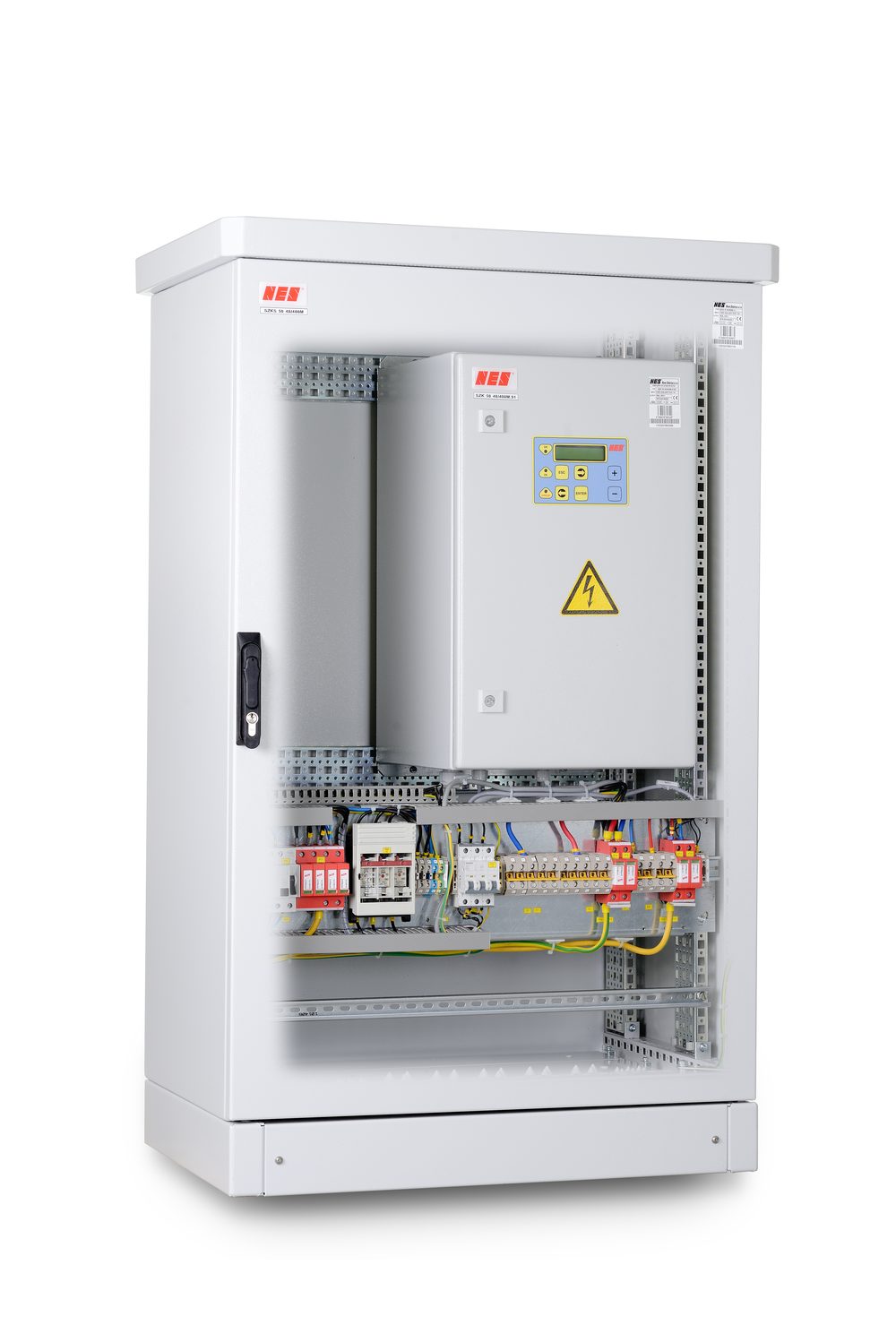
- Complete station (SZKS) for greenfield sites
Finally
Survey and monitoring
If instant-off surveys are part of the maintenance regime, specify the integrated interrupter rather than hiring one each time. If the site is remote or the asset is critical, specify communications at purchase — retrofitting is possible but rarely cheaper.
- Integrated interrupter and relay
- GPS synchronisation across multiple units
- RS-485 Modbus to SCADA or DataScape
Multi-zone systems
Modular protection for concrete and complex structures
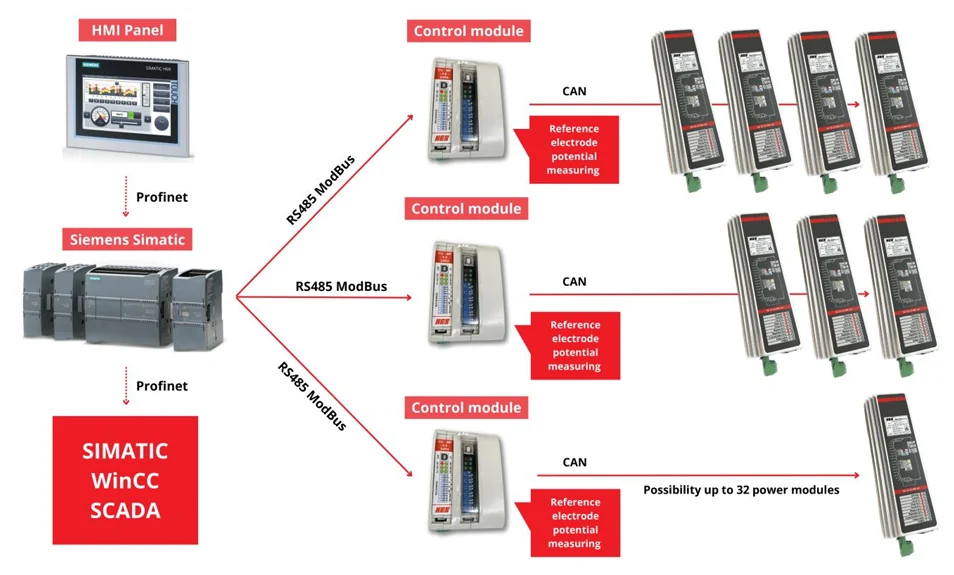
Not every structure can be protected from a single output. Reinforced concrete, storage tanks and offshore structures need current delivered zone by zone, each one measured and adjusted on its own. NES builds these as modular systems rather than as one large rectifier.
Zones
Independent control per zone
Each control module drives its own group of power modules and takes its own reference electrode measurement, so zones are regulated separately rather than sharing one setpoint.
- Up to 32 power modules per system
- Reference electrode potential per zone
- CAN between control and power modules
Integration
Built to sit in your control system
Control modules report over RS-485 Modbus to a Siemens Simatic PLC, with Profinet to a local HMI panel and to SCADA. It can equally report into DataScape where there is no site control system.
- RS-485 Modbus · Profinet
- Siemens Simatic and WinCC SCADA
- DataScape remote monitoring
Applications
Where zoning matters
Structures where current demand varies across the asset, or where sections must be isolated for testing and depolarisation surveys.
- Reinforced concrete structures
- Storage tanks
- Offshore and marine structures
Service and support
Backed for the life of the asset
Every unit ships with manufacturer's warranty and engineering support behind it. Beyond that, cover programs can be tailored to client requirements.
Standard
Included with every unit
Supplied as part of the purchase, at no ongoing cost.
- Manufacturer's warranty
- Commissioning and configuration support
- Technical advice from CP engineers
- Spares and units held in Melbourne
Agreement
Service level agreement
An annual option that puts a committed number on turnaround.
- Repair or replacement in 7 business days
- Acknowledged within 4 business hours
- Priority allocation from Australian stock
- Metropolitan attendance included
Monitored
Diagnosis before dispatch
With DataScape, output trends usually identify the problem before anyone travels.
- Rectifier faults told apart from ground bed faults
- Technicians attend with the right parts
- 24/7 alarming and trending
- Retrofittable to any make of rectifier
Common questions
Terminology, standards and specifying
Terminology
Is a transformer rectifier unit the same as a CP rectifier?
Yes. Transformer rectifier unit, TRU, T/R unit, transformer-rectifier and cathodic protection rectifier all describe the same equipment — the mains-powered DC supply that drives current from an anode bed onto the protected structure in an impressed current system. Terminology varies by industry and by country; the specification does not.
Spelling
Polarisation or polarization?
Both are correct — Australian and British practice uses polarisation, North American practice uses polarization. Australian Standard AS 2832 uses the s spelling. Datasheets sourced from the United States will use the z spelling for the same measurement and the same criterion.
Anodes
Anode bed or groundbed?
Same thing again. Anode bed, groundbed and ground bed all refer to the buried or immersed anode array that discharges current into the electrolyte. Its resistance is usually the largest single component of circuit resistance, and therefore the main driver of the output voltage a rectifier needs.
Sizing
What output rating do I need?
Current follows from surface area and coating condition; voltage follows from total circuit resistance. Add margin for coating degradation and anode consumption across the design life. The selecting-a-rectifier section above works through it, or send us the structure details and we'll size it.
Surveys
Can these do instant-off surveys?
Yes. An interrupter and switching relay are integrated rather than supplied as a separate box, and GPS synchronisation allows multiple units across a pipeline to interrupt together. No hired interrupter, and no need to open the cabinet to fit one.
Retrofit
Can a new unit replace an existing rectifier?
Usually. The switchmode design is considerably more compact than an equivalent transformer-and-variac unit, so it generally drops into an existing cabinet with room to spare. We did exactly that on a Victorian gas asset where the enclosure was too small for any conventional replacement. Send us the cabinet dimensions and the existing unit's rating and we'll confirm.