
The failure was flagged, not discovered
A transformer-rectifier protecting a Victorian gas distribution asset stopped producing output. It was not our equipment — the unit had been supplied by another manufacturer some years earlier.
Because the installation was reporting into DataScape through a DataCell logger, the loss of output was flagged rather than waiting to be found at the next scheduled potential survey. Depending on the survey cycle, that alone can be the difference between a day without protection and several weeks.
Monitoring does not care who built the rectifier. If it produces a signal, it can be watched.
Unprotected time matters on buried steel carrying gas. It is both a corrosion risk and a compliance gap, and it does not improve while a procurement process runs.
The constraint others could not get past
The existing enclosure was small. Every conventional transformer-rectifier priced against the job needed a larger cabinet.
That sounds like a detail. It isn't. A new enclosure means a new plinth, civil works, re-cabling and the approvals that go with them — turning a like-for-like replacement into a project measured in months rather than days, with the asset unprotected throughout. The cabinet itself is rarely the expensive part.
The NES SZK fitted the existing enclosure. The range is built to a notably compact footprint for its output — the same current from considerably less cabinet than a conventional transformer-rectifier of equivalent rating.
The operator kept the enclosure, the plinth and the cabling.
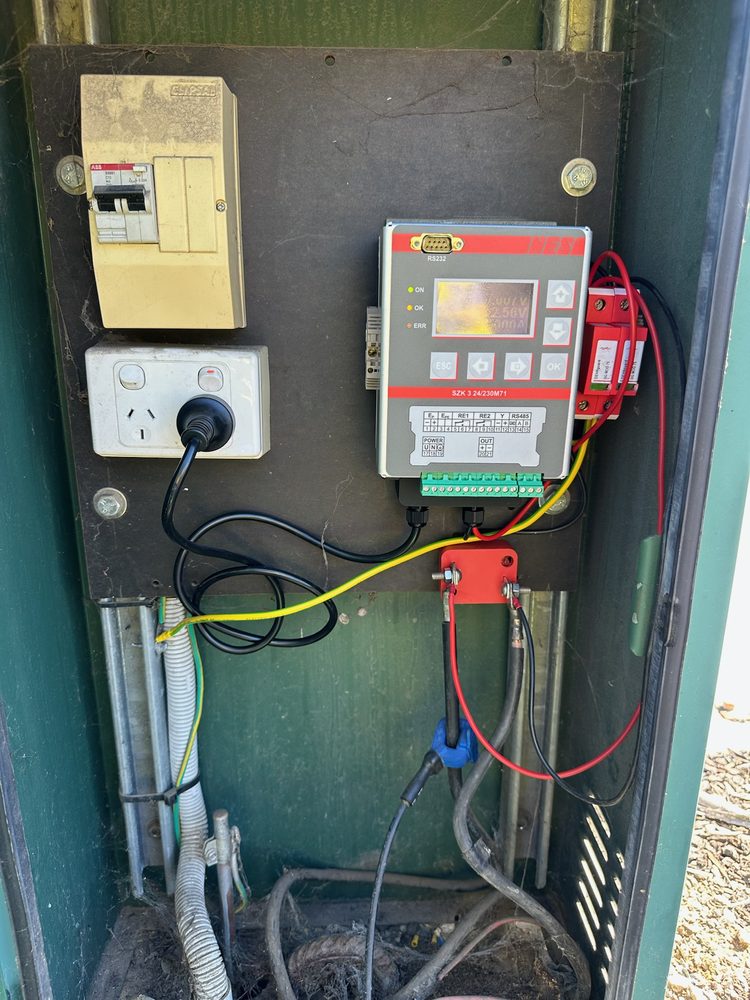
Same-day response, Melbourne stock
We answered the enquiry and identified the solution the day it came in. The unit was held in our Mitcham stock, so there was no European lead time to wait out.
Rather than ship a boxed rectifier and leave setup to site, we configured it in the workshop first — output parameters set for the asset, regulation mode selected, interrupter configured, and the unit bench-tested before dispatch.
That is the difference between a delivery and a solution. The work remaining on site was connection, not commissioning.
Thirty minutes on site the following day
The asset owner's own team carried out the changeover. Because the unit was pre-configured and fitted the existing enclosure, the whole operation took approximately thirty minutes — no specialist attendance, no contractor to schedule, no outage window beyond the changeover itself.
Protection was restored the day after the enquiry came in.
Why it worked
- Monitoring caught it — the failure was flagged, not discovered weeks later at survey.
- Same-day response — the enquiry was answered and the solution identified the day it came in.
- The unit fitted — a compact footprint meant no new enclosure, no civils, no approvals.
- It was in Melbourne — local stock of a European product, available immediately.
- It was configured first — the workshop did the thinking so the site didn't have to.
- The operator's own crew installed it — thirty minutes, no specialist attendance required.
The installation was subsequently recognised by NES Nová Dubnica, who highlighted it in their own announcement of the Australian distributorship.
It doesn't have to be our equipment
The rectifier that failed here was not one of ours, and the asset owner was not an existing customer of the NES range. That is normal. We monitor, diagnose and replace cathodic protection equipment regardless of who originally supplied it.
If you have a rectifier that has stopped doing its job — or one you have been told needs a new cabinet — it may not. We hold NES transformer-rectifiers and spares in Melbourne, configure them to your site before dispatch, and have the manufacturer's documentation and factory diagnostic tooling for the full range.
Would you know if yours failed?
The reason this took a day rather than months started long before the rectifier failed — the asset was being monitored. DataCell and DataScape report potential, current, output and run hours across water, gas, rail and industry, whoever built the asset.